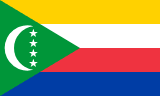

Comoros
Last Updated: 2026-04-02
Official Portal: Government of Comoros
Embassy Finder: Comoros Embassies Worldwide
Quick Facts
| Category | Details |
|---|---|
| Residency for naturalization | 10 years lawful residence |
| Language requirement | Comorian, French, or Arabic (working knowledge; no formal test) |
| Civics test | None |
| Processing time | Variable; highly dependent on political context |
| Naturalization fee | Administrative fees (standard route); substantial fees for economic citizenship |
| Dual citizenship | Not explicitly prohibited; tolerated in practice |
| Citizenship by birth in Comoros | Conditional jus soli |
| Citizenship by descent | Primarily through the father; limited maternal transmission |
| Governing law | Loi No. 79-12 of 12 December 1979 (Code de la Nationalite Comorienne), as amended |
Dual Citizenship
Comoros does not have a clear, unambiguous position on dual citizenship. The 1979 Nationality Code contains provisions allowing for loss of Comorian nationality upon acquisition of a foreign citizenship, but these provisions are rarely enforced.
In practice: Comoros tolerates dual nationality. The large Comorian diaspora in France (estimated at 300,000+ people, primarily in Marseille and Paris) overwhelmingly holds dual Franco-Comorian nationality. The government has never systematically enforced the loss provisions.
Economic citizenship program: Comoros has operated one of the most controversial citizenship-by-investment programs in the world. Beginning in 2008, the government entered into agreements — primarily with the United Arab Emirates and Kuwait — to grant Comorian citizenship to stateless bidoon residents of Gulf states. Tens of thousands of passports were reportedly issued in exchange for government revenue. This program has been widely criticized for:
- Lack of transparency in fees and beneficiary selection.
- Passports being issued to persons with no connection to Comoros.
- Allegations of corruption and misuse of funds.
- The program has been suspended and restarted multiple times, with varying legal frameworks.
The economic citizenship program is distinct from standard naturalization and has no bearing on the rights of ordinary Comorian citizens or standard applicants.
Mayotte complication: The island of Mayotte, geographically part of the Comoros archipelago, voted to remain under French sovereignty in 1975 when the other three islands declared independence. Comoros continues to claim Mayotte as part of its territory (a position supported by multiple UN General Assembly resolutions). Persons born in Mayotte hold French nationality. The status of Mayotte creates unique dual-nationality-adjacent situations for families split between the French and Comorian islands, though legally these are distinct sovereignties.
Acquisition of Nationality
By Birth (Jus Soli)
Comoros applies limited jus soli:
- A child born in Comoros to at least one parent who was also born in Comoros acquires nationality at birth (double jus soli).
- A child born in Comoros who would otherwise be stateless acquires Comorian nationality.
- A foundling discovered in Comoros is presumed Comorian.
- Birth on Comorian territory alone to two foreign parents does not confer nationality.
By Descent (Jus Sanguinis)
The 1979 Code retains a patrilineal preference:
- A child born to a Comorian father acquires nationality at birth, regardless of place of birth.
- A child born to a Comorian mother and a foreign father has a more limited claim. The Code does not automatically transmit nationality through the mother in the same manner as through the father. Amendments and constitutional equality provisions have created ambiguity, but the patrilineal rule remains dominant in practice.
- Comorian society is matrilineal in many respects (particularly in property inheritance on Grande Comore), creating an interesting tension between customary practice and the nationality law’s patrilineal bias.
By Adoption
A minor child adopted by a Comorian citizen may acquire Comorian nationality. The adoption must be recognized under Comorian law. Given the influence of Islamic family law (Comoros is constitutionally an Islamic republic), adoption procedures follow kafala-like principles in some contexts, though formal adoption (adoption pleniere under the civil code) does exist. The interplay between Islamic personal status law and the French-derived civil code creates procedural complexity.
Statelessness risk for adopted children: Children adopted through kafala who are not biologically connected to a Comorian parent face potential statelessness if their country of origin does not recognize the arrangement as conferring continued nationality.
By Marriage
A foreign woman who marries a Comorian man may acquire nationality by declaration. The government retains the right to oppose.
A foreign man who marries a Comorian woman does not benefit from the same facilitated route and must naturalize through the standard process. This gender asymmetry reflects the patrilineal structure of the Nationality Code.
By Naturalization
| Requirement | Details |
|---|---|
| Lawful residence | 10 years of habitual residence in Comoros |
| Good character | No criminal convictions; good morals |
| Health | Sound physical and mental health |
| Means of subsistence | Must demonstrate economic self-sufficiency |
| Integration | Demonstrated assimilation into Comorian society |
| Language | Working knowledge of Comorian, French, or Arabic |
| Fee | Administrative fees |
| Decision | By decree of the President of the Union |
Economic citizenship (distinct from standard naturalization): The government has sold citizenship through various schemes since 2008. These programs have operated outside the standard naturalization framework, typically under special legislation or executive decree. Costs have reportedly ranged from $45,000 to $60,000 per person, with bulk pricing for Gulf state partners. The program’s status changes frequently based on political leadership.
Loss and Renunciation
Voluntary renunciation: A Comorian citizen who has acquired another nationality may renounce by declaration. Renunciation must not render the person stateless.
Involuntary loss:
| Ground | Details |
|---|---|
| Voluntary acquisition of foreign nationality | May lead to loss, but rarely enforced |
| Fraud | Nationality obtained by fraud may be withdrawn |
| Acts against the state | Acts prejudicial to Comorian interests |
| Unauthorized foreign military service | Without governmental authorization |
Restoration of Nationality
Former Comorian citizens who lost nationality may apply for restoration by decree. The process follows a pathway similar to naturalization. Given the country’s small administrative apparatus, restoration applications are handled on a case-by-case basis.
The question of Mayotte (the fourth Comorian island, which remained under French sovereignty after 1975) creates unique restoration issues. Persons born in Mayotte before 1975 who identify as Comorian, and their descendants, occupy a legally complex position under both Comorian and French law.
Stateless Persons and Foundlings
- A child found in Comoros (foundling) is presumed Comorian until proven otherwise.
- A child born in Comoros to stateless parents acquires Comorian nationality.
- The economic citizenship program was originally framed as an anti-statelessness measure for Gulf bidoon populations, though its humanitarian effectiveness has been widely questioned.
- Comoros has not ratified the 1954 or 1961 Statelessness Conventions.
Document Checklist
- Completed nationality application form
- Birth certificate (original + certified copy)
- Valid passport or identity document
- Proof of 10 years habitual residence (for naturalization)
- Criminal record clearance
- Medical certificate of good health
- Proof of means of subsistence or employment
- Marriage certificate (if applying via marriage)
- Two passport-size photographs
- Proof of renunciation of prior nationality (if required)
Sources
-
Loi No. 79-12 du 12 decembre 1979 — Code de la Nationalite Comorienne. https://www.gouvernement.km/
-
Constitution of the Union of the Comoros (2001, revised 2009 and 2018) — Nationality provisions. https://www.gouvernement.km/
-
UNHCR Refworld — Comoros nationality law profiles. https://www.refworld.org/
-
Global Citizenship Observatory (GLOBALCIT) — Country profile for Comoros. https://globalcit.eu/
-
Transparency International — Reports on the Comorian economic citizenship program. https://www.transparency.org/
-
Le Monde diplomatique / Reuters — Investigative reporting on the Comoros passport scheme and Gulf bidoon citizenship grants.